

When you go to festivals, markets or pop-ups, sooner or later you will run into reality: power on site is either unavailable, expensive or weak/unreliable. That is when you need a generator. A well-chosen generator gives you freedom, but a poorly chosen one can do the exact opposite – tripping breakers, voltage fluctuations, noise, stress and, in the worst case, a safety problem.
In this article we will show you how to choose a generator for a food trailer or food truck based on real consumption, which type suits sensitive appliances (coffee machine, refrigeration, beer dispenser) and how to set it up so that it is as quiet and safe as possible.

1) First, get clear on this: should the generator cover the “baseline” or the whole operation?
In practice, there are 2 scenarios:
A) Generator as a backup / supplement (semi-off-grid)
- you have 230V or a weak hookup on site,
- the generator covers only part of the equipment (e.g. refrigeration + lights),
- goal: keep things running when something fails or the hookup is not enough.
B) Generator as the primary source (off-grid events)
- you are going to an event with no hookup or a limited one,
- the generator has to handle the whole menu and the peaks,
- goal: stability, quiet and enough power even at start-up.
Tip: The more “primary” the generator is, the more it pays to invest in a higher-quality setup and good placement (noise, exhaust, service, safety).
2) Generator output: calculate the peaks, not just the kW on paper
When choosing a generator, it is not enough to add up the “power ratings” on the labels.
The right approach:
- Make a list of the appliances that may run at the same time.
- Distinguish between:
- running load,
- starting load – a short peak at start-up (compressors, pumps, refrigeration).
- Add headroom (typically 20–30 %) so that the generator is not constantly running at its limit.
The most common power “killers” in a food trailer or food truck:
- electric heating (fryer, grill, oven, hob),
- instantaneous water heating,
- air conditioning,
- compressor refrigeration and freezers,
- some professional coffee machines while heating up.
Appliance / equipment (TOP) | Running load (kW) | Start-up peak (kW) |
1) Commercial fridge (1–2 doors) | 0,30 – 0,80 | 1,5 – 2,5 |
2) Freezer / chest freezer | 0,20 – 0,60 | 1,0 – 2,0 |
3) Ice maker (small/medium) | 0,25 – 0,80 | 1,0 – 2,5 |
4) Espresso machine (1–2 group) | 2,0 – 5,5 | 3,0 – 7,0 |
5) Dishwasher (under-counter) | 2,0 – 3,5 | 2,0 – 3,5 |
6) Instantaneous water heater / 6L boiler | 1,5 – 9,0 | 1,5 – 9,0 |
7) Extraction / hood | 0,10 – 1,00 | 0,3 – 2,0 |
8) Air conditioning / space cooling | 0,70 – 3,00 | 2,0 – 6,0 |
9) Contact grill / panini press | 1,8 – 3,5 | 1,8 – 3,5 |
10) Electric fryer (1 tank) | 3,0 – 6,0 | 3,0 – 6,0 |
3) 230V vs 400V: when do you need a 3-phase generator?
If your equipment is split across several circuits/phases, you can distribute the load so that you do not overload a single branch.
At Gastronova, our standard connection is 400V 32A CEE, split into three circuits (phases). On request, we can also prepare a configuration for 3×230V, depending on the type of business and the availability of hookups at events.
- A 230V generator is often enough for simpler concepts (lights, refrigeration, beer dispenser, some coffee machines).
- A 400V (3-phase) generator makes sense for higher outputs, several large appliances or when you want a more stable load distribution.
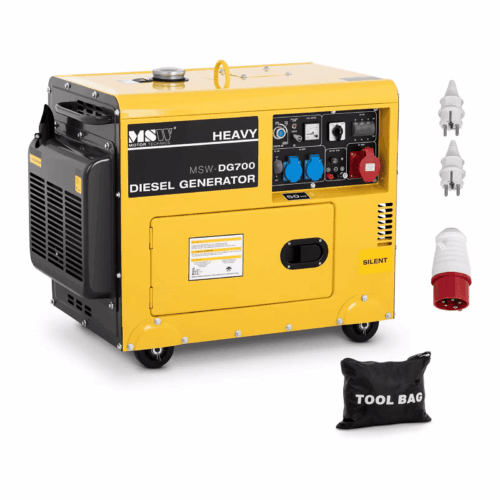
Recommendation: Diesel generator https://gastronova.eu/produkt/dieslovy-generator/
4) Inverter vs conventional generator: which is better for catering?
Inverter (“clean power”)
- typically quieter and more economical under variable load,
- often better suited to more sensitive equipment (electronics, some control units).
Conventional
- often better value in €/kW and robust,
- with sensitive electronics, it depends on the quality of regulation and the specific model.
If your setup includes sensitive items (coffee machine, electronic controls, POS, LED systems), an inverter/“clean power” is the safer choice.
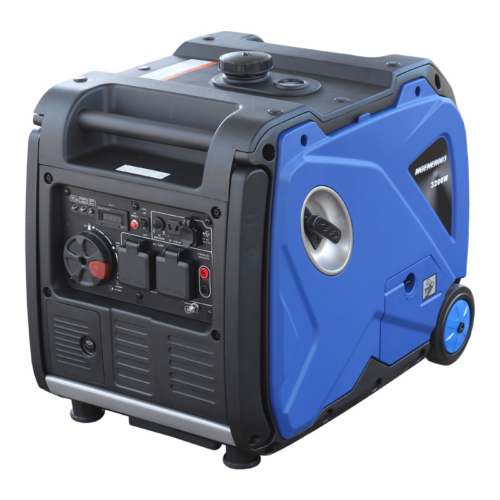
Recommendation: Petrol generator https://gastronova.eu/produkt/benzinovy-generator/
5) Generator placement: why we recommend the back-of-house area behind the trailer
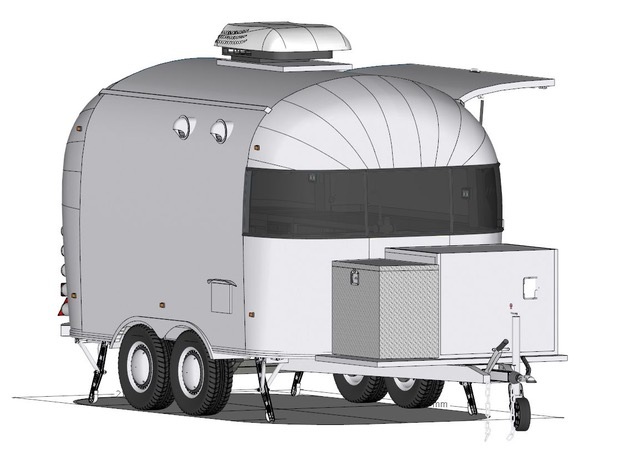
Even though we offer a generator box, in practice we most often recommend placing the generator in the back-of-house area behind the trailer– especially with larger units (diesel in particular).
The reasons are simple:
- noise: the generator will not disturb customers at the serving window,
- exhaust fumes: you reduce the risk of fumes drifting towards staff or customers,
- drawbar load (tow hitch): large generators at the front can negatively affect weight distribution and trailer handling; with some large units it may not even be technically possible.
Summary:
- a box is fine for smaller, lighter solutions or specific setups,
- but our default recommendation is the back-of-house area behind the trailer (quieter, safer, more practical).
6) Safety: CO, ventilation and “never in an enclosed space”
Generators produce carbon monoxide (CO). The basic rule: the generator always outdoors and in a very well-ventilated area, away from windows/doors/vents and positioned so that the exhaust does not blow towards people or into the trailer.
Minimum checklist for a safe setup:
- the generator runs outdoors only,
- enough space around it (intake/exhaust),
- cables rated for the load (no DIY extension leads),
- stable placement (so it does not vibrate and “wander”),
- refuel only after it has cooled down.
7) How we do it at Gastronova: custom electrics + inspection
Electrics in a food trailer or food truck cannot be done “by eye”. Different menus = different appliances = different circuits and load distribution.
That is why with us:
- we design the electrical wiring to measure, based on the concept and the specific appliances,
- the design is done by a certified electrician in Slovakia,
- and the electrical installation is then checked and handed over with an inspection report.
8) When is it better to go for gas instead of a bigger generator?
If you have large electrical loads (fryer, grill, oven, water heating), it is worth considering gas alternatives:
- you reduce peak kW demand in the trailer,
- you reduce electricity costs at festivals,
- you increase self-sufficiency.
Sometimes it is cheaper and more stable to switch one large appliance to gas than to buy a significantly bigger generator.
8) When is it better to go for gas instead of a bigger generator?
If you have large electrical loads (fryer, grill, oven, water heating), it is worth considering gas alternatives:
- you reduce peak kW demand in the trailer,
- you reduce electricity costs at festivals,
- you increase self-sufficiency.
Sometimes it is cheaper and more stable to switch one large appliance to gas than to buy a significantly bigger generator.
Gastronova’s recommendation
If you want the generator in your food trailer or food truck to work without stress:
- list of appliances + real operating pattern,
- peak calculation + headroom,
- 230V vs 400V decision based on the concept,
- generator placed in the back-of-house area behind the trailer (noise, exhaust, weight),
- trailer electrics custom-designed and with an inspection report.
If you like, we can help you design the configuration (circuits, connection, generator choice and a safe setup) so that it works in practice at events – and so that the technology is not what ruins your day.
FAQ – Generator in a food trailer or food truck
1) What generator do I need for a food trailer or food truck?
It depends on whether the generator is meant to be a backup (covering only part of the operation) or the primary source (powering everything). The best approach is to list the appliances, determine what runs at the same time, factor in start-up peaks and add headroom.
2) Why is it not enough to add up appliance kW “on paper”?
Because some appliances have start-up peaks (refrigeration, freezers, air conditioning, pumps), and in practice there are overlaps (several things switch on at once). If the generator is constantly running at its limit, the voltage will fluctuate or it will cut out.
3) Is a 230V or a 400V generator better?
- 230V is often enough for simpler concepts (lights, refrigeration, beer dispenser, some bar equipment).
- 400V (3-phase) makes sense for higher outputs, several “heavy” appliances or if you want to spread the load across phases (more stable operation).
4) Inverter or conventional generator – which is better?
An inverter (clean power) is usually better for more sensitive equipment and is often quieter under variable load. A conventional one is usually robust and better value in €/kW. What matters is choosing based on what you are powering (coffee machine, electronics, POS, LED).
5) Where should the generator be placed?
In general, we recommend placing the generator in the back-of-house area behind the trailer – especially larger diesel units. You reduce noise at the window, limit exhaust fumes near customers and avoid problems with drawbar load.
6) What is a generator box good for, and when is it not suitable?
A box is useful for smaller solutions or specific setups (protection, tidiness, cable routing). With larger generators, however, weight, noise and the need for substantial ventilation can be limiting – which is why the back-of-house area behind the trailer is usually more practical.
7) Is it safe to use a generator near the trailer?
Yes, if the generator is always outdoors, has sufficient ventilation and the exhaust is directed away from people and away from the trailer. Never run it in an enclosed space or “in a cabinet without air supply”.
8) When is it better to choose gas instead of a bigger generator?
If you have large electrical loads (fryer, grill, oven, water heating), it is sometimes better to switch one large appliance to gas than to buy a significantly more powerful generator. You reduce peaks and increase your independence at events.