
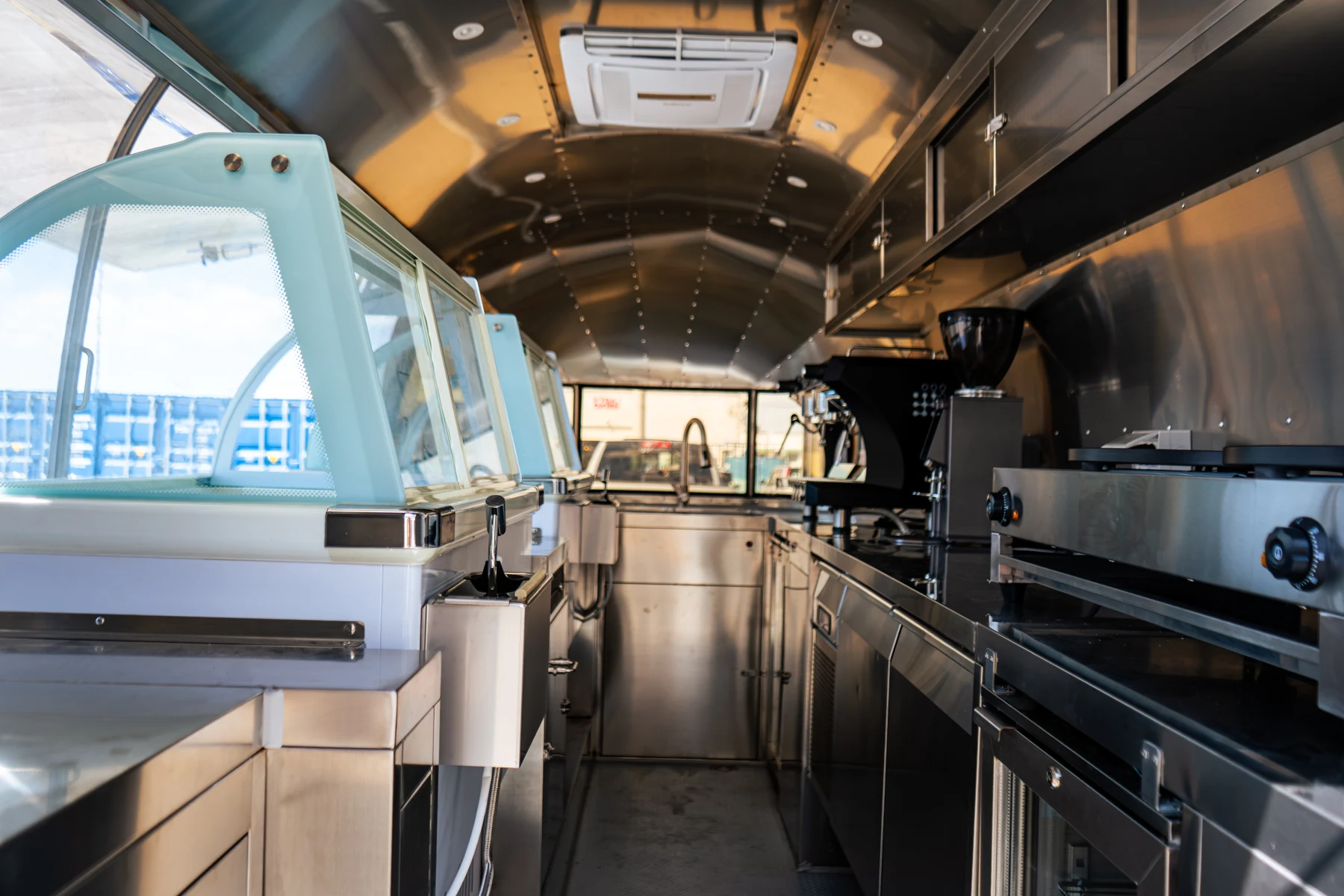
Mobile catering is becoming an increasingly popular business segment. If you are considering entering this industry, one of the key questions is whether to invest in a motorised food truck or a food trailer. Both options have their advantages and disadvantages, but the right choice can significantly affect the costs, flexibility and success of your business.
This article will help you better understand the differences between these two solutions and show you which option makes more sense in terms of cost, maintenance, flexibility and long-term return on investment.
1. Initial costs and investment
One of the most important factors in the decision is the purchase price.
Food trucks are significantly more expensive, as they combine the vehicle and the kitchen equipment in one.
Building a quality food truck can cost tens of thousands of euros, and the bigger and better equipped the vehicle, the higher the price.
With food trailers the initial costs are lower, because you only buy the trailer and not an entire drive system.
Most entrepreneurs try to minimise their investment at the start so they have more money for marketing, ingredients or staff.
2. Maintenance and repair costs
Food trucks and trailers differ significantly in their long-term maintenance and repair costs.
Food trucks have an engine and gearbox that require regular servicing and, in the event of a breakdown, can bring the entire business to a halt.
Repairs to the engine, gearbox or other mechanical parts can be time-consuming and costly.
Trailers have no engine or gearbox, which means fewer maintenance worries and lower service costs.
If the towing vehicle breaks down, you can hitch the trailer to another car and carry on with your business without a lengthy break.
3. Flexibility and mobility
Mobility is one of the main reasons entrepreneurs choose food trucks or trailers.
Food trucks are self-contained vehicles that can move quickly to different locations without the need for another vehicle.
Trailers require a towing vehicle, which can limit how quickly you can relocate.
Once the trailer is unhitched, you can use the car for other purposes, which makes it more useful.
Although food trucks are somewhat more mobile, when transporting larger quantities of goods or ingredients it can be more advantageous to have a separate car and trailer.
4. Adaptability and expansion options
The ability to adapt the interior and exterior to the needs of the business also plays a major role in the decision.
Food trucks have limited space that is fixed by the size of the vehicle.
If you want a bigger food truck, you have to buy a new vehicle, which is costly and impractical.
Food trailers offer more size options, from compact models to large, fully fledged kitchens.
If the business grows, the trailer is easier to swap for a larger one or to extend with another module.
For long-term growth it is therefore important to choose a solution that offers greater variability and customisation options.
5. Regulatory requirements and approvals
Every mobile catering unit must meet strict hygiene and safety standards.
Food trucks are motor vehicles and are therefore subject to stricter technical inspections, emission standards and registration requirements.
Trailers have less complicated regulatory requirements and their approval tends to be simpler.
In the European Union, food trucks must be registered as commercial vehicles, which can present additional administrative challenges.
Gastronova trailers are 100 % EU-homologated, which simplifies their registration and commissioning.
For new entrepreneurs, simpler legislation is a big advantage because it speeds up getting the business started.
6. Operating costs and fuel consumption
Food trucks have higher operating costs because:
They consume more fuel, as you have to power both the engine and the electrical appliances.
Insurance for a food truck is more expensive, as it also covers the value of the vehicle and the kitchen equipment.
In the event of a mechanical breakdown, you have to deal with repairing the whole vehicle, not just the kitchen.
Trailers have lower operating costs because they have no engine and can be towed by various types of vehicles, which may be more economical.
Conclusion – why is a food trailer the better choice?
When choosing between a food truck and a food trailer, it is important to consider costs, flexibility, maintenance and legal requirements. Based on all the factors compared, food trailers prove to be the better investment for most entrepreneurs.
✔ Lower initial costs – a food trailer is more affordable than a food truck
✔ Cheaper maintenance and fewer servicing worries
✔ The flexibility to change or expand your business without having to buy a new vehicle
✔ Simpler legislation and fewer administrative hurdles
✔ Lower operating costs and more efficient fuel consumption
📩 Would you like a quote for a food trailer? Contact us and we will help you choose the ideal model!